
Fixed bid. Shorter calendar. Lower number.
We design and build web applications, integrations, and AI-powered workflows for mid-sized businesses — quoted as projects, not hours. Our mastery of AI tooling means a senior team ships in weeks what used to take a quarter, and that productivity shows up in the price we quote you.
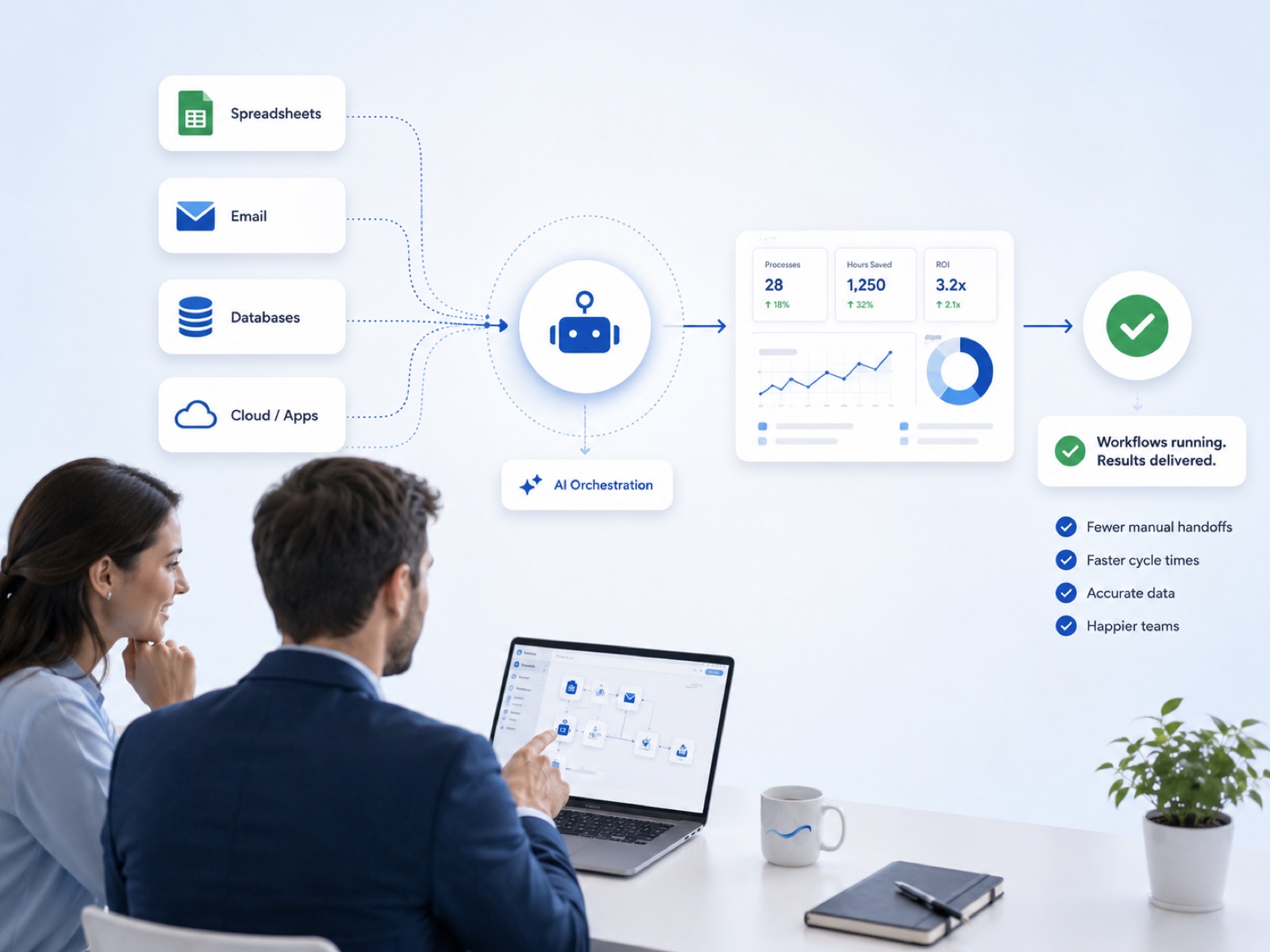
What we build
- Web applications and portals. Customer-facing and internal — front end, back end, auth, roles, reporting. Responsive, fast, and maintainable after we leave.
- Integrations. Your accounting, CRM, dispatch, payroll, and e-commerce systems talking to each other, with retries, logging, and audit trails instead of a nightly CSV someone babysits.
- AI workflows and agents. Document and email parsing, classification, drafting, scoring, extraction, and routing — with humans kept at the decisions that actually need them.
- Business process automation. We chart the workflow, rank it by ROI, and automate the part that pays back first — order to invoice, intake to schedule, quote to contract.
- Design, accelerated by AI. Interface and workflow design produced in days, not weeks, then refined with your team.
- Measured outcomes. Every engagement ships with an hours-saved or revenue-affecting target, and the reporting to prove it.
For worked examples — platforms built, problems solved, and what they replaced — see the founder's project history at linkedin.com/in/rick-geyer.
What this looks like in production.
Three screens from platforms we designed and built — a workforce operation running at scale, AI screening every applicant who walks in the door, and a conversational agent capturing leads on a trade-show floor.
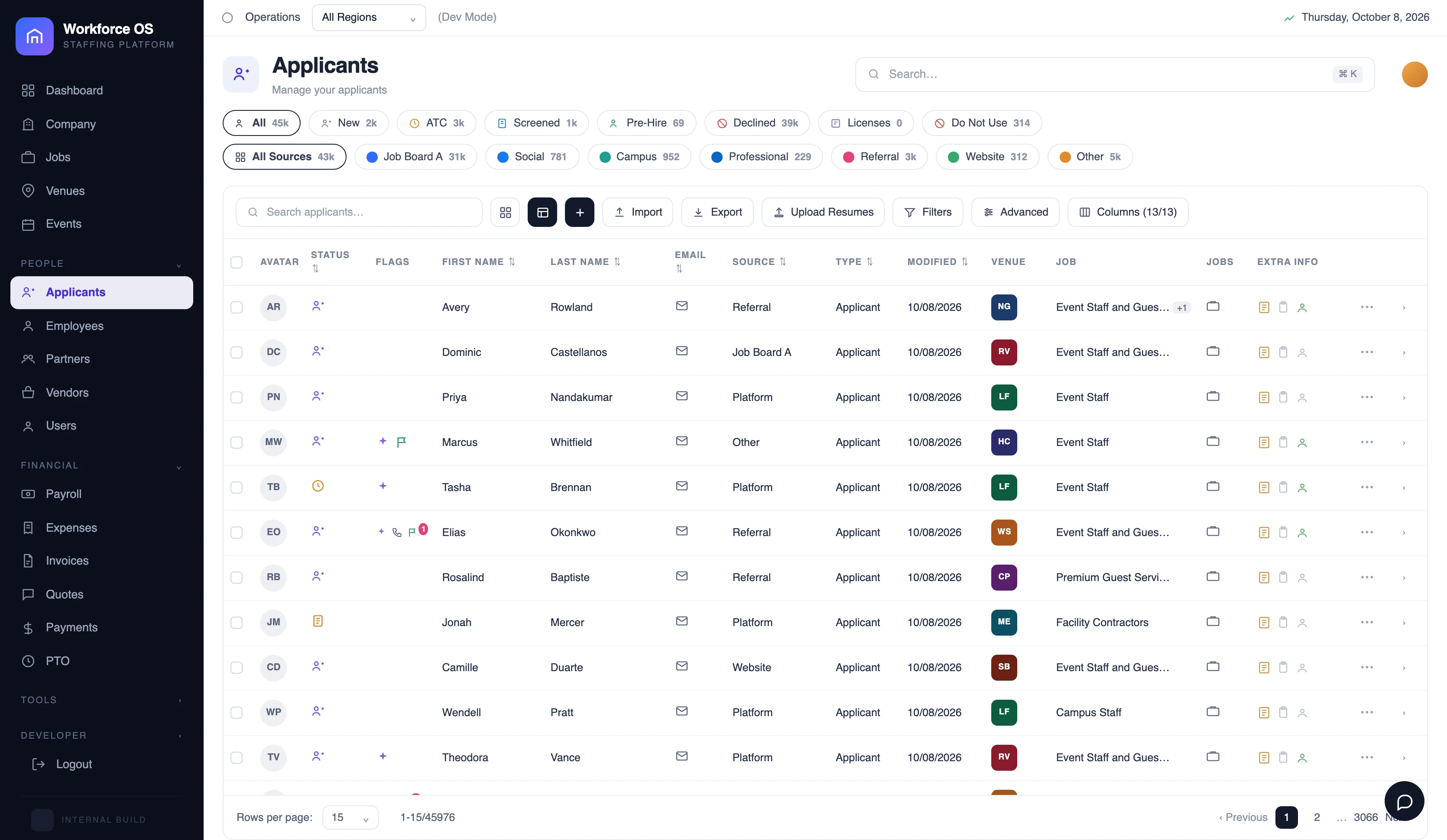
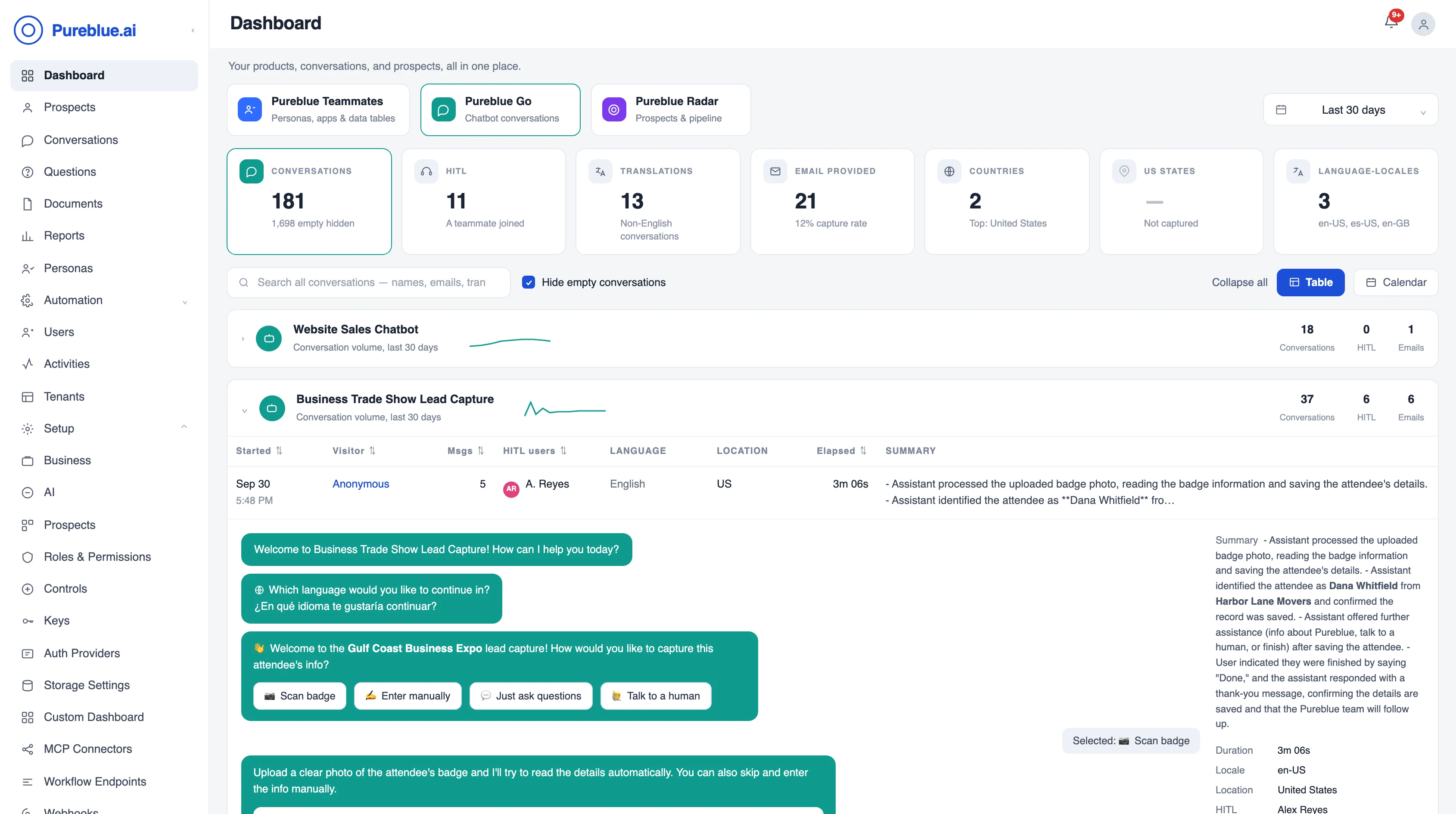
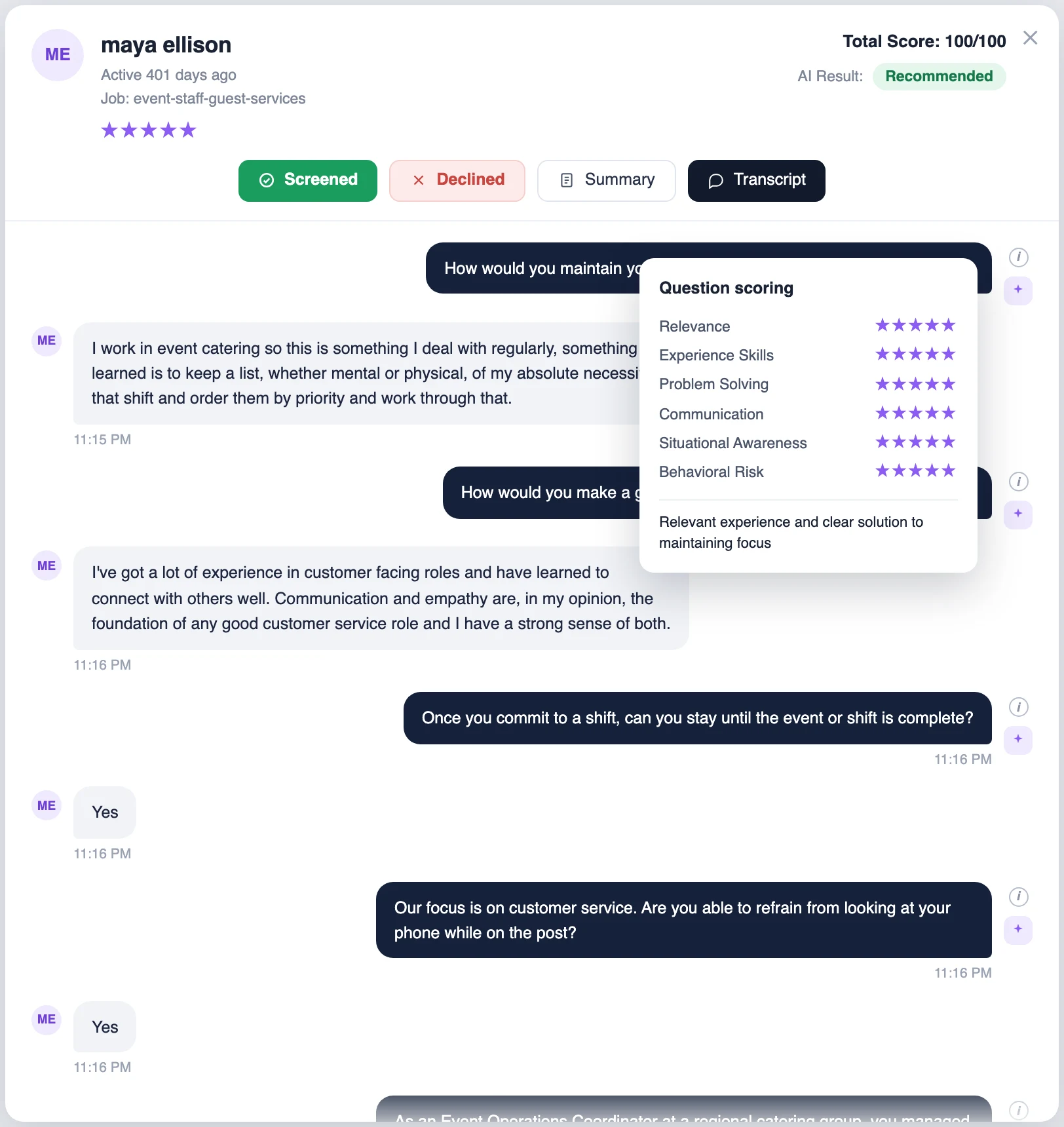
AI screening that shows its work.
Every applicant gets interviewed and scored against six criteria — relevance, experience, problem solving, communication, situational awareness, behavioral risk. The score isn't a black box: open any question and you see the rating and the one-line rationale behind it.
That's discipline #2 — evaluation and quality judgment — built into the product rather than bolted on. A recruiter can audit any call the model made, which is the only reason anyone trusts it enough to act on 46,000 of them.
Recreated with synthetic data. No customer, applicant, or attendee information is shown.
We bid the work, not the hours.
Hourly billing quietly pays a vendor for being slow. We quote a phase at a fixed number with a defined deliverable — so the speed we get from AI lands in your budget instead of our timesheet. If we finish early, that was the point.
A number, before you start
Scope, price, and delivery date agreed up front. Change orders are explicit and rare, because the demo settles most of the arguments early.
Demo before dollar
Before you commit, we build a small working demo of your solution — your branding, your data, your workflow. You evaluate a finished flow, not slideware.
Phase one is short
Typically 4–8 weeks to something in production. Larger programs follow results — never the other way around.
Anyone can get AI to write code. Keeping it correct is the job.
The market has split: demand for generalist builders is flat, while companies pay $150K–$400K for people who can make AI systems behave — roughly three open roles for every qualified candidate, and about 142 days to fill one. Those roles all screen for the same seven disciplines. They are exactly how we work, and they are why our systems hold up after the demo.
1 · Specification precision
Agents follow instructions literally, not charitably. We write specs exact enough that the literal reading is the one you wanted — which is also what makes a fixed bid safe to give.
2 · Evaluation & quality judgment
The most-cited skill in the market, and the one most shops skip: automated tests for AI output that catch answers which sound confident and are wrong. If it can't be evaluated, it doesn't ship.
3 · Multi-agent decomposition
Hard work gets split — a planner that holds the goal, sub-agents that each do one bounded job. Narrow jobs are checkable jobs; one giant prompt is not.
4 · Failure-pattern recognition
We design against the known failure modes: context degradation, spec drift, agents agreeing with bad data, wrong tool choice, cascading errors — and silent failures, the dangerous ones, which is why everything is instrumented and logged.
5 · Trust & security design
Guardrails and human checkpoints placed by how costly and how reversible a mistake would be. Drafting an email is not sending a payment, and the system shouldn't treat them alike.
6 · Context architecture
Deciding what the system always knows versus what loads per task. Get it wrong and quality decays as the work grows; get it right and the system stays sharp under load.
7 · Cost & token economics
Modeling cost and ROI across models — the right model for each step, not the priciest one everywhere. It's a large part of why we can quote lower and still deliver.
Underneath it all · the three layers
Plain-language playbooks, AI for judgment, deterministic code for anything that must not fail. A 90%-per-step system is a coin flip after five steps. See how we work →
The demo-first model
Before you commit, we build a small working demo of your automated process — your branding, your data shapes, your workflow. You watch an order come in by email, get parsed, scheduled, and invoiced — and then decide.
We build on powerful AI platforms — Pureblue.ai among them — which is how a small senior team delivers production software this quickly.
Fit
Who it's for
50–500-employee businesses in events, field services, logistics, insurance, distribution, property management, and professional services — and software companies that need a senior team to build a product they can't staff for.
Who it's not for
Enterprises with big internal dev teams, and anyone shopping for slideware. We ship working software or we don't take the engagement.
What phase one looks like
One or two processes automated completely, or one application in production, with your team trained and the result measured.
Common questions
Do you work fixed bid or hourly?
Fixed bid. We scope a phase, quote a number, and deliver it. Hourly billing pays us for slowness; a fixed bid means our AI leverage shows up in your price instead of our margin.
Why is a fixed-bid AI project cheaper than a traditional quote?
Because the same senior team produces far more per week with AI handling design iterations, boilerplate, test scaffolding, and first-draft integrations. We bid the work, not the hours, so that productivity lands on your side of the table.
How do you keep quality high when AI writes a lot of the code?
With seven disciplines: precise specification, automated evaluation of AI output, multi-agent decomposition, failure-pattern recognition, trust and security design, context architecture, and token-cost economics. They are the same skills the market is paying $150K–$400K for, and they are what separate a system that demos well from one that survives production.
What kinds of projects do you build?
Web and mobile-responsive applications, customer portals, internal tools, API and system integrations, document and email processing pipelines, agentic workflows, and end-to-end business process automation.
Do we see anything before we commit?
Yes. We build a small working demo of your solution — your branding, your data shapes, your workflow — so you evaluate a finished flow rather than a proposal deck.
Get a fixed-bid number on your project.
A short call, a look at what you need built, and a scoped phase with a price and a date — plus a ranked ROI map if you're not sure where to start.
Start the conversation